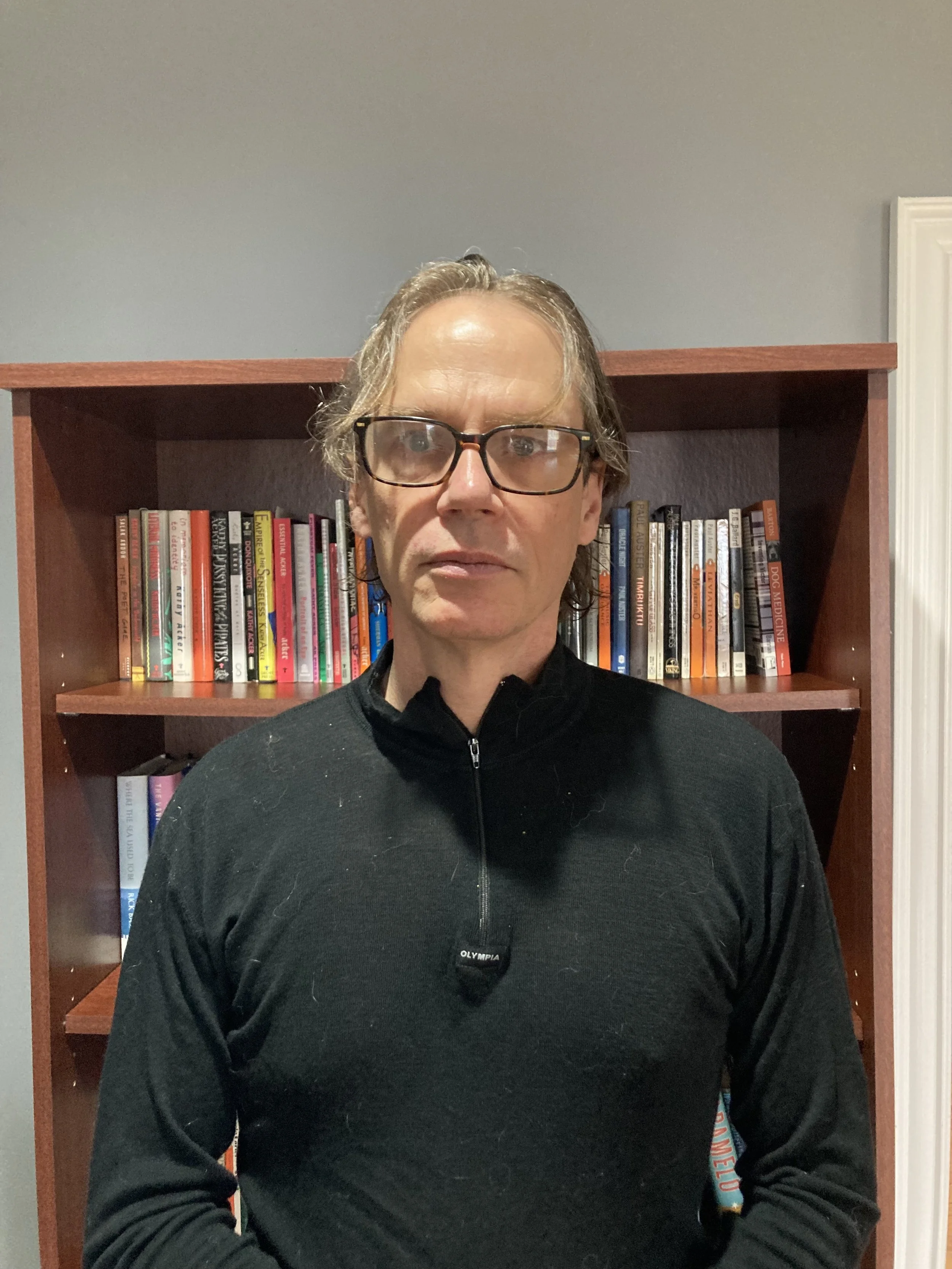
Michael Hardin
Originally from Los Angeles, Michael Hardin lives in rural Pennsylvania. He is the author of a poetry chapbook, Born Again, from Moonstone Press (2019), has had poems and CNF published in Seneca Review, Wisconsin Review, North American Review, Quarterly West, Moon City Review, Lunch Ticket, among others, and has been nominated for a Pushcart.
Immersion
“My mother is a fish.”
William Faulkner. As I Lay Dying.
In the early 1970s, ARCo gave away pairs of “ARCo Animals” with each tank of gas. A station was next to our church, Emmanuel, so my father filled up each Sunday after the morning service. I liked collecting things—wheat pennies, feathers, baseball cards—and even at four, fixated on completeness. All the animals: check. The ark: check. Noah and his wife: no. The toybox in the church nursery, however, had both.
The human body is not 70-80 percent water—the fact I grew up with—except in infancy; it decreases rapidly to roughly 60 percent in males and 55 in females.
At San Dimas High’s outdoor pool, in early June 1988—my first day as a lifeguard—a fifth grader walked to the end of the diving board, looked down into 12 feet of chlorinated water, and slunk back to the ladder. His classmates began teasing him, so he reversed direction again. I knew how this would end and told him he should climb down, but he seemed more terrified of his peers than drowning and stepped off the end. Fortunately, humans are relatively buoyant, and his head popped up, but he was struggling and his eyes locked on mine—save me. Less than a second to reach him, and maybe two more to pull him to the side.
During fetal development, humans possess pharyngeal arches—they resemble gills but actually have nothing to do with underwater breathing. Early in the development of evolutionary theory, it was surmised they might be a remnant from our aquatic past, but that was eventually dismissed. Creationists, including my biology teachers at Maranatha High School, used the simple fact they are not gills to refute evolution.
“And, behold, I, even I, do bring a flood of waters upon the earth, to destroy all flesh, wherein is the breath of life, from under heaven; and every thing that is in the earth shall die.”
Genesis 6:17
A 2023 Scientific American article contends that comets were not the primary source of water on earth—their deuterium to regular hydrogen ratios are simply too high. The hydrogen carried on solar wind has a ratio that is too low. Carbonaceous chondrites, a type of meteorite, hold water with a ratio that is much closer. The author posits that our planet’s water resulted from all three sources, as well as reactions within the earth of hydrogen and oxygen present at its formation.
“Do you want me to sign you up to be baptized with Tim and Deb?” Water generally follows the path of least resistance, my lifelong strategy with my father. Much of my fear of speaking in tongues—being baptized in the Holy Ghost—was that the congregation would stare. At Foothill Christian Center, the baptismal font was behind the pulpit—the focal point of every congregant. My brother was eight and my sister eleven—if I said “no,” my father would question my faith and conviction, would commit himself to saving my soul, which was not lost, just introverted.
At four, I clearly had the devil in me. Most Sunday mornings and evenings, I sat in the sanctuary next to my mother listening to the sermon, but one night she put me in the nursery with my sister. My sin felt both premeditated and instinctual: I reached for the two-inch tall figures at the bottom of the toybox and pulled out a wooden dog with the same action—my diversion. Emmanuel’s nursery was also the pastor’s secretary’s office, and I found a space under a table to feign interest in the dog while slipping Noah and his wife into my pocket. During the two-hour service, I pulled the dog in circles, praying the bulge in my pants would not condemn me.
I had seen that look five or six years before, in my parents’ pool—a young son of some church friends was in the shallow end and accidently let go of the side. His head wouldn’t break the surface, and I could read the terror in his eyes, and gently nudged him back to the edge. None of the adults noticed. The boy, realizing he was safe, started letting go on purpose, knowing I wouldn’t let anything happen.
NOAA’s website (National Oceanic and Atmospheric Administration) mentions that more than 70 percent of the earth’s surface is covered with water. Does the acronym mean the planet is doomed and they’ll pack us in a spaceship made of gopher wood.
The theft was the easy part, enjoying my prize more problematic. Monday morning, while my mother was washing the breakfast dishes, I introduced Noah and his wife to their animal charges and the boat. Not wanting my mother to see my loot, I played behind my father’s Lay-Z-Boy. When the dishes were done, she came in and questioned why I was behind the chair. I held out Noah and his wife and confessed, although in retrospect I doubt she would have realized my set was incomplete. She was furious and spanked me with a wooden spoon—stealing from the church could not be tolerated. That was the preamble; when my father came home—he worked across the street for my grandfather’s United Evangelical Churches—he would deal with me.
When I was in fourth or fifth grade, my mother inherited about $10,000 from her grandmother. We were staunchly working class, although my parents always defined us as middle. I remember my mother paying bills at the end of the month, knowing exactly how long it would take before the check would be charged against her account. Instead of paying off debt or creating a college fund, my parents opted for a swimming pool. The Rapture was predicted before my high school graduation.
Emmanuel was a tiny church without a baptistry. Pastor Chaney thought our new pool would be perfect for baptisms, an L.A. interpretation of the Jordan River. As a ten-year-old watching my pastor immerse white-robed members in the shallow end, memories of peeing in that spot and playing “Marco-Polo” kept invading my mind.
Maybe my early sin against the church prevented my father from ever expressing pride in me—experience tells me he inherited his own father’s lack of the milk of human kindness—but when he came in and my mother told him, the belt came off. He that spareth his rod hateth his son. I don’t remember physical pain, just his visceral anger, and him telling me I would have to confess to Pastor Chaney Wednesday night before service. Confessing to my pastor was humiliating—I knew “Thou shalt not steal” and “the wages of sin is death,” so when he repeated those verses, I acted contrite and penitent, promising never to sin again. From that point on, my place was next to my mother in the sanctuary.
“But whosoever drinketh of the water that I shall give shall never thirst; but the water that I shall give him shall be in him a well of water springing up into everlasting life.”
John 4: 14.
Baptisms at Foothill Christian Center, the church we switched to, followed a schedule, the final Sunday night of each month. That evening, it was my siblings, me, and one older woman. After the offertory, we filed into a special room behind the sanctuary, one I had never entered. Pastor Gaston told me, as the oldest male, I would be first, then the other woman, my brother, and my sister. He directed us to changing rooms to get into our swimsuits and robes. When he called me into the baptismal font, I made sure not to look out into the congregation, and stepped toward him. I pinched my nose as he said, “In the name of the Father, and of the Son, and of the Holy Ghost.” And as he immersed me, “I baptize you.” I emerged to a few “Amens” and “Hallelujahs,” and walked past my brother to the changing room, feeling no.
“If anyone who was suffering, in the body or the spirit, walked through the waters of the fountain of Bethesda, they would be healed, washed clean of pain.”
Tony Kushner. Angels in America, Part Two: Perestroika.
Thalassophobia encompasses both the fear of deep bodies of water and the fear of drowning. Each summer, from the age of seven, I took Red Cross swim lessons at Arcadia High’s outdoor pool. Beginner (twice), Advanced Beginner, Intermediate, Swimmer. Water deeper than I could stand in terrified me, and back then, on the last day of each two-week session, kids were required to jump off the diving board to pass. Having a backyard pool did not diminish the fear. We had a slide into five feet of water, and my parents bribed me to go down—probably a quarter. I climbed the ladder which was not much taller than I, sat at the top, then clutched the top rail while my feet had nearly reached the end. My father snapped a photo—it’s ensconced in an album next to one of my brother’s swollen face from a big sting.
I preferred books to toys, except my Noah’s ark. While the crew installed our pool, my brother and his friend Jamie threw my ARCo animals into the flood control channel behind our house—they were irretrievable. His action was warranted—I tormented him as only an older brother could. About fifteen years ago, I found ARCo sets on eBay—I now have two sets: one in original packaging and another was for my kids to play with, although without a biblical upbringing, neither was interested. Nostalgia and trauma can be difficult to navigate.
In 1995, I brought Claire to California to introduce her to my parents. Although she attended Pomona College, she had never been to Catalina. We biked around the island, and afterwards I suggested snorkeling at Avalon beach. Despite having anxiety, asthma, and no experience, she agreed, the chance to swim with fish winning out. I had learned in our pool with gear from Kmart, and went once in Kauai. After a few frantic attempts, she figured it out. Years later, we took Blake and Julian snorkeling in Silfra, Iceland, in a crevice created by the North American and Eurasian plates pulling apart. The water was crystal, barely a degree above freezing. The age requirement was 13, so we added two years to Julian’s on the waiver. This past week, he snorkeled in the Galapagos, last fall Claire and Blake went in Bermuda. Even though our last common ancestor was 470 mya, swimming among a school of fish feels natural.
According to the Jet Propulsion Laboratory at Caltech, six moons in our solar system likely have liquid water oceans beneath their outer surface: Jupiter’s moons Callisto, Europa, and Ganymede; Saturn’s moons Enceladus and Titan; and Neptune’s moon Triton. Since all life on earth requires at least some liquid water to exist, scientists look for evidence of water when searching for extraterrestrial life. Researchers at NOAA speculate that as many as twenty-five percent of exoplanets have liquid water, although it may be subsurface. Water water everywhere…
My lifeguard training has taught me that I am safe in the water, regardless of depth, but the phobia has merely been transferred to others, most notably my children. Our local pool, the Danville Area Community Center (DACC), offered swimming lessons. I had worked with Blake on my own, but knew formal lessons were more effective. From the gallery, I watched, ready to dive in and rescue her, even though they all wore life vests. As she progressed onto the swim team, the fear did not abate. Julian, who screamed during his first lessons, generated more anxiety. Any time either was in the water, I was on maximum alert. Boat trips were dreadful, whether taking the ferry across Puget Sound to see my parents or touring Anchorage Bay, I imagined them falling into the frigid water and me diving in after them. Only recently, while walking along the coast near Anacortes, WA, did I realize, if Blake fell in, she was a far stronger swimmer than I. She’d be okay.
Burning Bush
“Mud slides, brush fires, coastal erosion, earthquakes, mass killings, et cetera. We can relax and enjoy these disasters because in our hearts we feel that California deserves whatever it gets. California invented the concept of life-style.”
Don Delillo. White Noise
This past January, Los Angeles burned, at least that was the media narrative I received in rural Pennsylvania. I grew up in the San Gabriel Valley—every summer a litany of brush fires, apocalyptically tinged sunsets. In 1979, my maternal grandfather, Donald Higbee, came down from San Jose to visit after one firestorm had come close enough that ashes fell like gray snowflakes on our lawn in Monrovia. On TV, kids stuck out their tongues to catch snow—I struggled to repress that temptation. Flames had decimated a rich enclave, Bradbury, less than half a mile away, so we climbed in the station wagon to bear witness to the devastation. Concrete foundations and chimneys were all that remained on most lots, except for one, as if the angel of death had passed over. Painted on its front door—As for me and my house, we serve the lord.
“And the Lord went before them by day in a pillar of a cloud, to lead them the way: and by night in a pillar of fire, to give them light.”
Exodus 13: 21
The earliest known Spaniard to pass through the area, Juan Rodriguez Cabrillo, referred to San Pedro as “Bahia de los Fumos o Fuegos” in 1542, Bay of Smoke or Fires.
Los Angeles in the 1970s proved the Last Days were upon us. My first memory, not quite three, is being tossed out of bed during the 1971 Sylmar quake. At Pasadena Christian School, air raid drills prepared us for a nuclear attack: Jesus or our desks would save us.
Grandpa Higbee was a contradiction, my only forebear with a college degree—in engineering nonetheless—but also the one most easily drawn into fringe religious movements and ideologies. He attended Jim Jones’ People’s Temple in San Francisco for a short time, and frequented the Rosicrucian Pyramid. Dispensationalism, the belief in the Rapture, consumed him once he read Hal Lindsey’s Late Great Planet Earth (1970).
“Then the Lord rained down upon Sodom and Gomorrah brimstone and fire from the Lord out of heaven.”
Genesis 19: 24.
Each evangelist who visited Emmanuel Assembly of God thundered that we were Gomorrah to San Francisco’s Sodom, that God would apologize to those cities at the Last Judgment for not destroying us quickly enough. They never failed to take their children to Disneyland.
Water and fire are paradoxical symbols within the biblical myth, both destructive and life-affirming. God destroyed humanity in the Great Flood, and Christ promised “living water.” Hell was a Lake of Fire, and the Holy Ghost appeared as flames on the apostles’ heads.
“It was a pleasure to burn.”
Ray Bradbury. Fahrenheit 451
What makes fire so mesmerizing? Or am I just a pyromaniac or a moth? In sixth grade, a friend told me his uncle burned the warts off his hand with a match. My dermatologist had used liquid nitrogen, but the warts came back half the time. Holding a match to your own skin until it blisters is difficult—you have to fight the body’s desire to pull away. Once the blister forms, pierce the flesh, drain the water, and rip off the skin, then burn the exposed raw layer. The wart never returns. Burning and cutting, I later read, are common in trauma victims. That was the year the abuse began.
“And the angel of the Lord appeared unto him in a flame of fire out of the midst of a bush: and he looked, and behold, the bush burned with fire, and the bush was not consumed.”
Exodus 3: 2
Turning water into wine, raising the dead were miracles that I could understand. A bush that burned without consuming lacked purpose. Charlton Heston standing before the technicolor burning bush in The Ten Commandments reduced the supernatural to the obscenely artificial.
I was raised Pentecostal, evangelical, and fundamentalist, the holy trifecta. To outsiders, those might seem like synonyms, but they’d be more accurately described as a Venn diagram with my church at the center. Pentecostal: we spoke in tongues. Evangelical: we wanted to proselytize the world. Fundamentalist: every word in the Bible was literally true—no metaphor. One Christmas, when I was eleven, my family went to Hawaii—our first vacation on an airplane. On the big island, we peered into Kilauea—bubbling lava escaping from the Lake of Fire.
Last year, in my composition class, a student asked to write his argument paper proving that God exists. When I told him that theologians have wrestled with this for millennia, and there is no definitive proof, he told me we were living in the last days, that all the prophecies had finally come to pass. I informed him that every generation from the time of Christ to the present has thought they were the last, he seemed unconvinced. “Google Hal Lindsey’s Late Great Planet Earth,” I said. ChatGPT wrote each of his assignments, which might be the best evidence that the Antichrist is alive and well—in the 1980s, a rumor spread that the supercomputer in Brussels that ran the world’s banking was nicknamed “The Beast.”
My son believes his generation is considerably more atheistic than preceding ones. Maybe. Or will the increase in firestorms and flooding due to climate change persuade people that the perpetually-promised Apocalypse is nigh?